Tuesday, November 4, 2008

Tihar: Festival of Lights (and cows, bulls, and dogs)


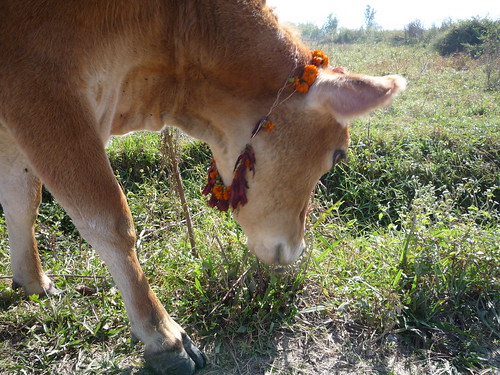
This past week was Tihar, the Nepali festival of lights (it corresponds to Diwali in India and, for purposes of alternate side parking suspension, New York City). The third day of the festival is Gai Puja, which is dedicated to worshiping cows. As you see here, they get a garland of marigolds along with a splash of red powder on their foreheads for the occasion.

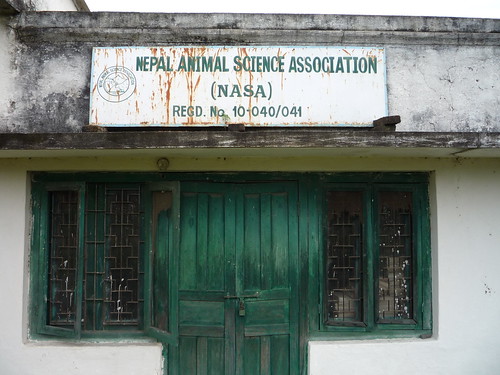
Incidentally, this guy is a ward of the state: he's with NASA, whose research fields are nearby our home.

Dept. of Motor Vehicles

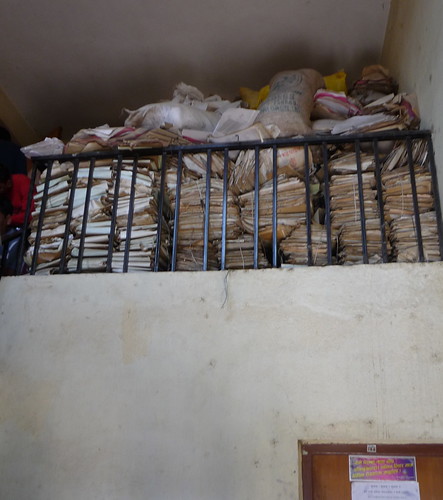
Records from the department of motor vehicles, where if you're registering a motorbike you're going to want to pay a fixer an extra 5 dollars to cut down your waiting time from eight hours to three.

Wednesday, October 15, 2008

Why, In a Road Accident, Sometimes It's Better To Kill Someone Than Injure Them

In Nepal, there are traffic jams, and then there are Jams. A traffic jam is when there are too many cars on too narrow a road. Maybe there's been an accident, which doesn't help things. But a Jam is something else altogether. It results from a small number of people exacting a kind of vigilante justice by shutting down all traffic over the course of hours, or even days, until their demands, usually remunerative, are fulfilled. It's like a Bandh, but it's not political.

We experienced a Jam in the village of Mugling a few hours outside Kathmandu. Our bus stopped nearby this bridge at the junction of two main highways. Traffic, as you can see, is backed up for miles. We didn't move for four hours, not even an inch.

Here's why: the day before, a bus had hit an old drunken man and injured him. But instead of stopping, the driver threw the bus in reverse and hit the man again, killing him. This was explained to us by one of our fellow passengers who said that it's cheaper for a driver to kill someone than to injure him. "If you injure him, you pay for his medical care for life. If you kill him, you pay only a fixed 15,000 rupee fine." (That's about $200). And so, she said, it's quite common for bus drivers, if they hit someone, to run over the victim until they're dead.

I, like you, was skeptical of this story, which sounded like an urban legend so completely heinous that it couldn't possibly be true. And yet *every single* nepali I've talked to since, 10 or 15 of them, confirmed that it's common. The economics of it do make sense, after all.

It turns out the fine isn't fixed, though. The Jam resulted when the man's family rejected the bus union's initial offer, and blocked traffic while attempting to negotiate a better settlement. The negotiations take place right there on the highway, in the company of an angry mob of villagers, beside the stopped cars in the heat of the afternoon sun. After four hours, the family settled on a price and traffic started moving again. As for the bus, it's windows were smashed and the rest of it torched.

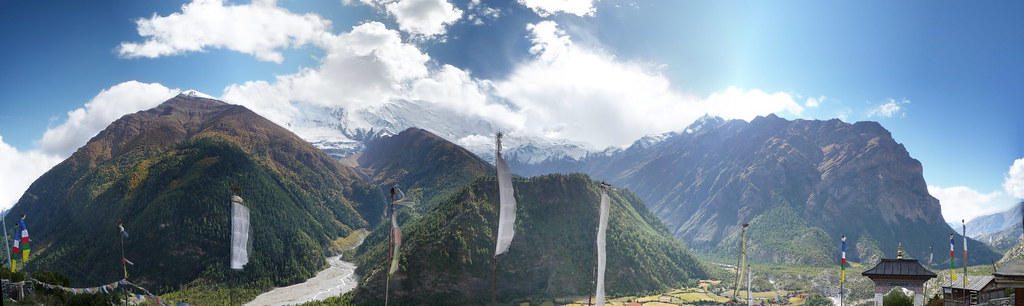
Incidentally, when this happened we were on our way back from a two week hike around the Annapurna Circuit in the Himalayas, which was spectacular. If pristine mountain scenery is your thing, you can see more pictures here.
Monday, October 13, 2008

Haircut Customs

I've always been interested in the rituals that accompany a haircut in different parts of the world. In Turkey for instance, a barber will trim your ear, nose, and upper cheek hair by singeing them with a burning stick of wood. So I was curious to see what kind of extras come along with a Kathmandu haircut.

The haircut itself is pretty standard. It's what comes after that distinguishes the experience: a full upper body massage and stretching treatment performed by the barber.

It begins with a mild back, arm and shoulder rub, and then becomes something like a combination of physical therapy, chiroprachty, and shiatsu dance. Arms forced behind my back in a chicken wing, knuckles cracked, palms rubbed, digits yanked one by one, forehead slapped, head punched with a closed fist, back cracked, full nelson neck stretch. And finally, as a slapstick finale, the barber put his hands together in prayer formation and slapped my hear 360 degrees around, making that hollow dip-can packing sound.

There is nothing more relaxing in the world.

Until you get charged double the standard price for the ordeal because you're a tourist.

Thursday, September 25, 2008

Technology Will Set You Free

Car exhaust is immensely more tolerable when you can enjoy the thrill of jockeying in and out of traffic.

Wednesday, September 24, 2008

Bandh II: Animal Sacrifice


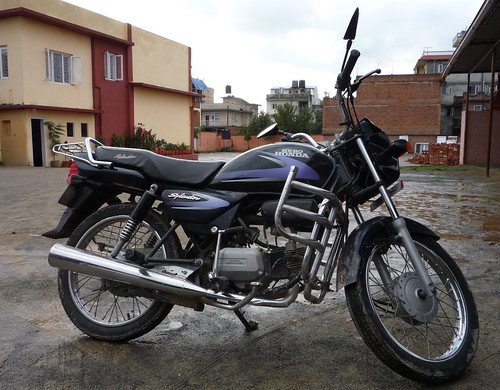
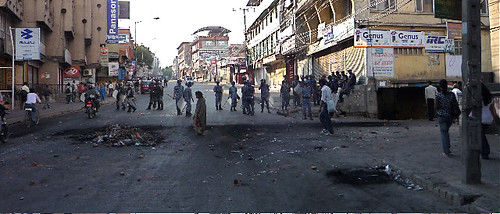
Another day, Another Bandh. I drove into the city earlier this week to get a motorcycle helmet, but couldn't get much past the Bagmati bridge because of a city-wide protest over animal sacrifice. In a sort of anti-PETA demonstration, Hindu protesters went ballistic over the new government's decision to cut off funding for animal sacrifice. To be clear: they were agitating *for* government money to buy animals for ritual sacrifice.

It started after the new federal budget, which incidentally is delivered C-SPAN like in an hours long live televised speech by the finance minister, declared the government would no longer purchase buffaloes, goats, chickens, ducks, and other animals, to be killed during hindu festivals. (during last year's Dashain Festival, religious sites in the city sacrificed 250 goats and 190 buffaloes, costing about $25,000 in taxpayer funds).

So protesters- mostly Newar people who were the original residents of the Kathmandu valley and make up the majority of the population now- closed down streets around the city, burnt tires, and lobbed tear gas at police. This is about more than money, though. It's about some Nepalis' fears that religion and traditional culture is under attack by the new secular maoist government.

So far, when it comes to culture, that government has been pretty active: forcing cancellation of the 2008 Miss Nepal Beauty Pageant and shuttering Kathmandu danceclubs after 11 PM. Next up? Banning liquor sales in neighborhood markets. The response to each has been similar: traffic shutdowns, or threats of city shutdowns. In a place where until very recently people haven't had much opportunity to exercise their political will at the ballot box, a robust culture of protest has flourished.

As for animal sacrifice, in the face of the protests the finance minister finally relented, claimed he had never stopped sacrifice funding in the first place, and reinstated the money in full.

Saturday, September 20, 2008

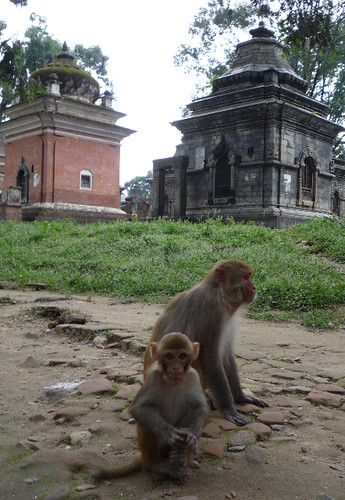
Obligatory Photo of Temple Monkey


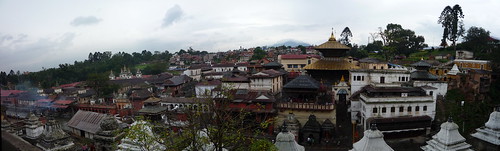
At Pashupati on the East side of the city, where the Bagmati river runs through a complex of Hindu temples. Cross-posted at cuteoverload.com.

The rest of Pashupati, including funeral pyres by the river, left: