Friday, November 28, 2008

First Hundred Days

This week our neighborhood supermarket, the reliable and humble Ram Store (which stores its yogurt at room temperature on the floor) began stripping its shelves of liquor, wine, and beer. The move was in response to new Maoist regulations which dictate that alcohol be sold only between 10 AM and 10 PM, under license, to I.D.'d individuals over the age of 18. All that was left at the Ram Store were a few boxed wines and a stray bottle of "White Magic" (a picture of whose label I really need to post). All in all, a less stringent alcohol policy than India, Pakistan, or New Hampshire, but still a decisive move in the direction of prudence.

This week also marked the end of the Maoist government's first hundred days in office. The Prime Minister, "Prachanda," who lead the Maoist insurgency from the jungles and the hills, has taken the party through a remarkably smooth transition from guerrilla movement to ruling political party within the space of a couple years. But now that they're ruling, the Maoists haven't been terribly productive or clear in their intentions. Among the Big Jobs they're assigned are writing a constitution and integrating their own rag tag army with the Nepali Army. So far they haven't really begun either one, and have instead been locked in semantic arguments within their own party over whether to establish Nepal as a "People's Republic" or a "Democratic Republic."

In the meantime, the YCL or "Youth Communist League," which is the thuggish youth wing of the party, has called regularly for bandhs and caused all sorts of other trouble including, most recently murdering two youths associated with a rival communist party. Militant unions associated with the Maoists also forced the closure *entire resort town* because the hotels wouldn't collectively pay its workers more than the minimum wage. These kinds of groups are extremely disruptive to the daily working life of Kathmandu, but it's tough to say how much the Maoist party controls them.

Among the most concrete changes the Maoists have brought are matters of simple law and order along the lines of the liquor regulations. The new government has also limited nightclubs to an 11 PM closing time, vastly expanded the presence of traffic police, and forced the suspension of the "Miss Nepal" beauty pageant (Trump should really consider buying the brand and relocating it to Vegas). I think many Nepalis have waited to see what kind of rulers the Maoists will be: radical, or pragmatic. And at least for now, it seems like they're continuing to wait for an answer.

Thursday, November 20, 2008

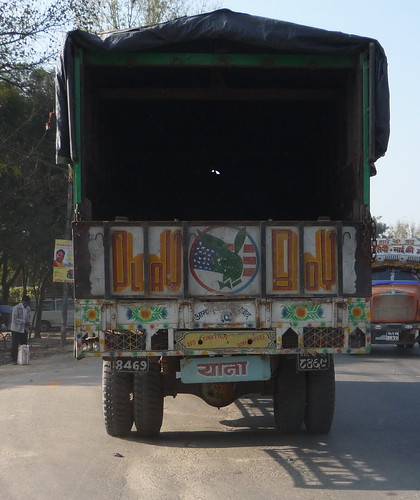
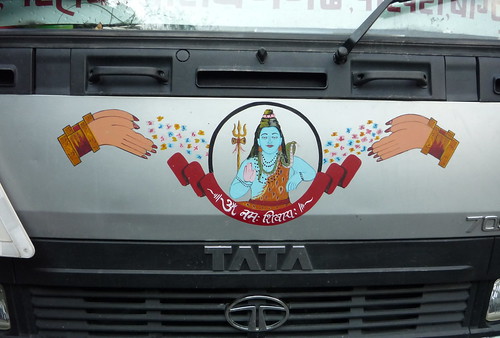
Truck Art


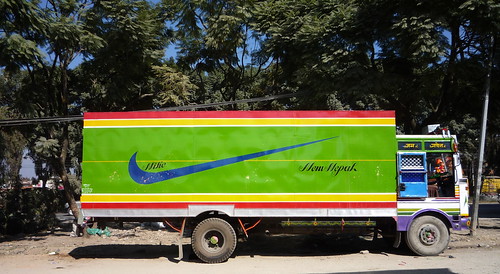
Standing out amidst the smog and dust of the Kathmandu streets, there is one especially vibrant source of refreshment: the custom truck art. Some of it is functional- "Horn Please, OK," some of it spiritual "Oh God, Save Me!." My favorite is a big-rig painted kiwi green with a nike logo and the declaration New Nepal.

Sunday, November 16, 2008

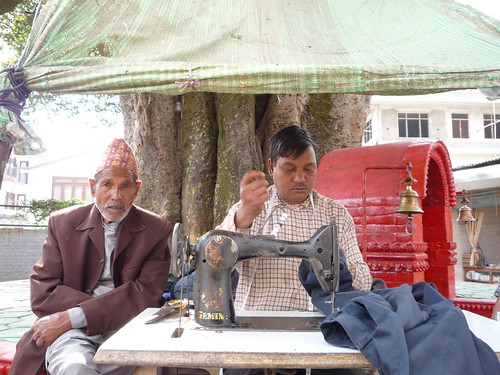
The Neighborhood Tailor

My new neighborhood tailor, working beneath a giant tree. He charges 50 cents to patch and blind hem a pair of pants.

Tuesday, November 4, 2008

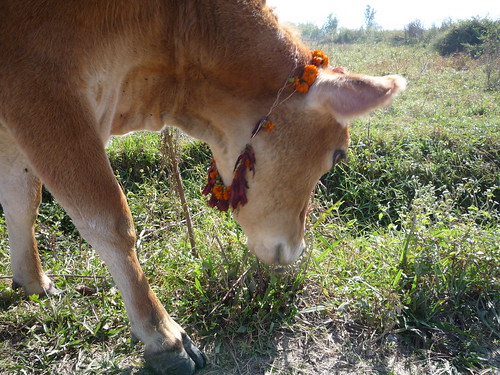
Tihar: Festival of Lights (and cows, bulls, and dogs)


This past week was Tihar, the Nepali festival of lights (it corresponds to Diwali in India and, for purposes of alternate side parking suspension, New York City). The third day of the festival is Gai Puja, which is dedicated to worshiping cows. As you see here, they get a garland of marigolds along with a splash of red powder on their foreheads for the occasion.

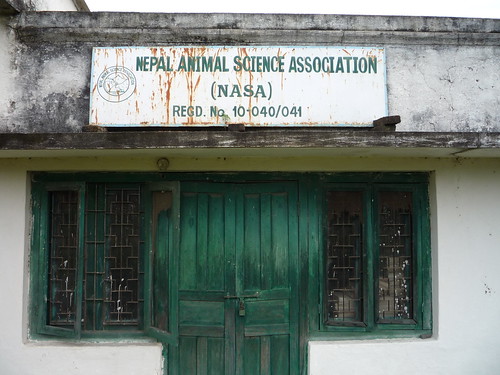
Incidentally, this guy is a ward of the state: he's with NASA, whose research fields are nearby our home.

Dept. of Motor Vehicles

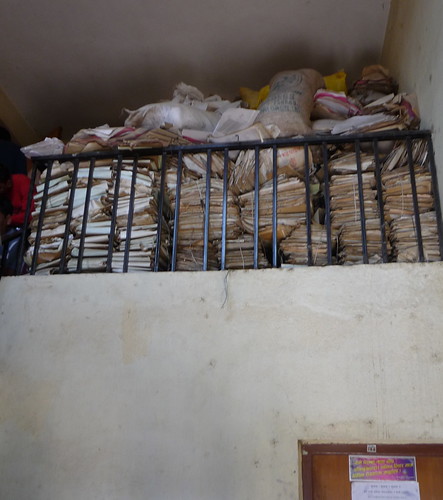
Records from the department of motor vehicles, where if you're registering a motorbike you're going to want to pay a fixer an extra 5 dollars to cut down your waiting time from eight hours to three.

Wednesday, October 15, 2008

Why, In a Road Accident, Sometimes It's Better To Kill Someone Than Injure Them

In Nepal, there are traffic jams, and then there are Jams. A traffic jam is when there are too many cars on too narrow a road. Maybe there's been an accident, which doesn't help things. But a Jam is something else altogether. It results from a small number of people exacting a kind of vigilante justice by shutting down all traffic over the course of hours, or even days, until their demands, usually remunerative, are fulfilled. It's like a Bandh, but it's not political.

We experienced a Jam in the village of Mugling a few hours outside Kathmandu. Our bus stopped nearby this bridge at the junction of two main highways. Traffic, as you can see, is backed up for miles. We didn't move for four hours, not even an inch.

Here's why: the day before, a bus had hit an old drunken man and injured him. But instead of stopping, the driver threw the bus in reverse and hit the man again, killing him. This was explained to us by one of our fellow passengers who said that it's cheaper for a driver to kill someone than to injure him. "If you injure him, you pay for his medical care for life. If you kill him, you pay only a fixed 15,000 rupee fine." (That's about $200). And so, she said, it's quite common for bus drivers, if they hit someone, to run over the victim until they're dead.

I, like you, was skeptical of this story, which sounded like an urban legend so completely heinous that it couldn't possibly be true. And yet *every single* nepali I've talked to since, 10 or 15 of them, confirmed that it's common. The economics of it do make sense, after all.

It turns out the fine isn't fixed, though. The Jam resulted when the man's family rejected the bus union's initial offer, and blocked traffic while attempting to negotiate a better settlement. The negotiations take place right there on the highway, in the company of an angry mob of villagers, beside the stopped cars in the heat of the afternoon sun. After four hours, the family settled on a price and traffic started moving again. As for the bus, it's windows were smashed and the rest of it torched.

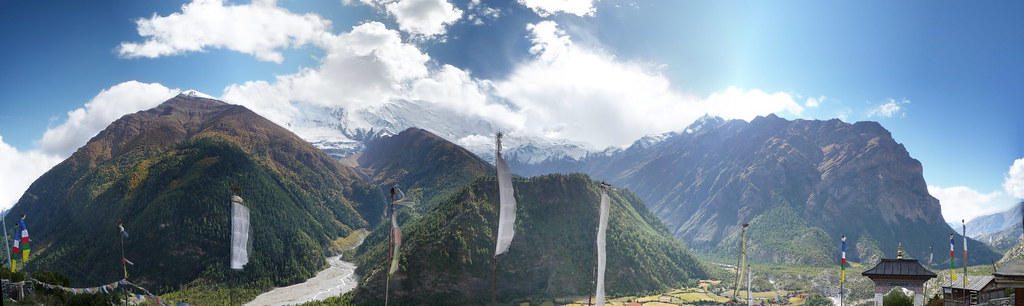
Incidentally, when this happened we were on our way back from a two week hike around the Annapurna Circuit in the Himalayas, which was spectacular. If pristine mountain scenery is your thing, you can see more pictures here.

Monday, October 13, 2008

Haircut Customs

I've always been interested in the rituals that accompany a haircut in different parts of the world. In Turkey for instance, a barber will trim your ear, nose, and upper cheek hair by singeing them with a burning stick of wood. So I was curious to see what kind of extras come along with a Kathmandu haircut.

The haircut itself is pretty standard. It's what comes after that distinguishes the experience: a full upper body massage and stretching treatment performed by the barber.

It begins with a mild back, arm and shoulder rub, and then becomes something like a combination of physical therapy, chiroprachty, and shiatsu dance. Arms forced behind my back in a chicken wing, knuckles cracked, palms rubbed, digits yanked one by one, forehead slapped, head punched with a closed fist, back cracked, full nelson neck stretch. And finally, as a slapstick finale, the barber put his hands together in prayer formation and slapped my hear 360 degrees around, making that hollow dip-can packing sound.

There is nothing more relaxing in the world.

Until you get charged double the standard price for the ordeal because you're a tourist.