Wednesday, September 24, 2008

Bandh II: Animal Sacrifice


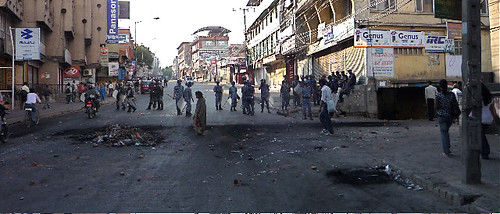
Another day, Another Bandh. I drove into the city earlier this week to get a motorcycle helmet, but couldn't get much past the Bagmati bridge because of a city-wide protest over animal sacrifice. In a sort of anti-PETA demonstration, Hindu protesters went ballistic over the new government's decision to cut off funding for animal sacrifice. To be clear: they were agitating *for* government money to buy animals for ritual sacrifice.

It started after the new federal budget, which incidentally is delivered C-SPAN like in an hours long live televised speech by the finance minister, declared the government would no longer purchase buffaloes, goats, chickens, ducks, and other animals, to be killed during hindu festivals. (during last year's Dashain Festival, religious sites in the city sacrificed 250 goats and 190 buffaloes, costing about $25,000 in taxpayer funds).

So protesters- mostly Newar people who were the original residents of the Kathmandu valley and make up the majority of the population now- closed down streets around the city, burnt tires, and lobbed tear gas at police. This is about more than money, though. It's about some Nepalis' fears that religion and traditional culture is under attack by the new secular maoist government.

So far, when it comes to culture, that government has been pretty active: forcing cancellation of the 2008 Miss Nepal Beauty Pageant and shuttering Kathmandu danceclubs after 11 PM. Next up? Banning liquor sales in neighborhood markets. The response to each has been similar: traffic shutdowns, or threats of city shutdowns. In a place where until very recently people haven't had much opportunity to exercise their political will at the ballot box, a robust culture of protest has flourished.

As for animal sacrifice, in the face of the protests the finance minister finally relented, claimed he had never stopped sacrifice funding in the first place, and reinstated the money in full.

Saturday, September 20, 2008

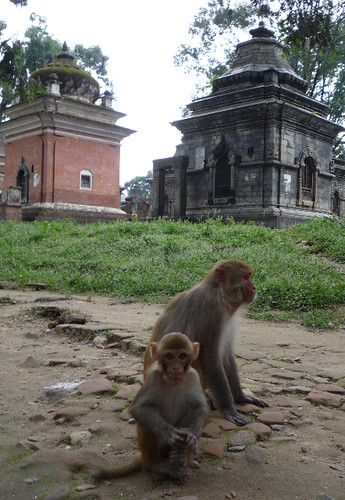
Obligatory Photo of Temple Monkey


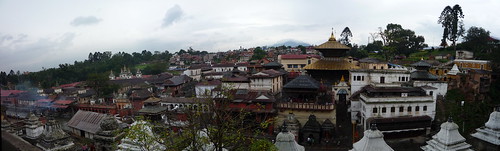
At Pashupati on the East side of the city, where the Bagmati river runs through a complex of Hindu temples. Cross-posted at cuteoverload.com.

The rest of Pashupati, including funeral pyres by the river, left:

Wednesday, September 17, 2008

Cosmic Air


This week I was searching for a rock bottom price for a Mumbai flight, knowing that once I arrived things could get pricey. So I visited Cosmic Air, Nepal’s low cost airline.

Cosmic air was once a promising private business in Nepal. It began in the nineties following de-regulation and benefited from a healthy number of tourist visits. Part of its advantage was that it was a budget airline and gave travelers more options in and out of Kathmandu which, for a city of a few million people, has relatively limited air service. At first cosmic flourished, becoming Nepal’s first private carrier to run jet service on domestic routes. They were to be the Jet Blue of Nepal, if you will. Then came the maoist insurgency, and tourist visits plummeted.

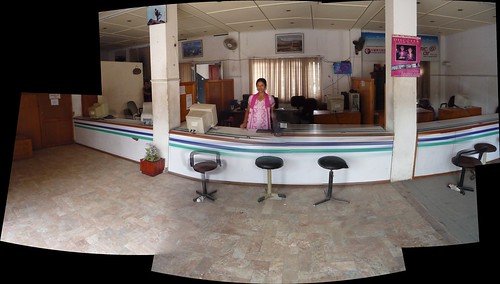
Now they look more like Pan Am. Cosmic has two airplanes, and both of them are currently grounded for maintenance. This week, their sales office in the Durbar Marg neighborhood of Kathmandu was dim and empty. The screens of computer terminals were blank and quiet. It had the feeling of an abandoned corner of a customs warehouse. Six employees still show up for work each day, waiting for the planes to be fixed so they can once again sell $100 fares to Delhi, or Varanasi, in India. It’s been this way for a month, and according to the sales person who revealed herself from behind a wooden cubicle, they’re not expecting the planes to be fixed until November.

Until then, they’re another stalled operation in downtown Kathmandu, with no electricity on this occasion even to make tea.

Saturday, September 13, 2008

Bandh!: "They Break Our Rules, We Break Their Windows."

(Bandh at school. Like a snow day, except with flying bricks and burning tires)
School's canceled, shops are closed, and there's no traffic on the roads. It's a bandh!

The bandh is a tried and true Nepali political tactic where an aggrieved group forces a citywide strike by blocking the streets, throwing bricks, and burning tires in the road. Taxi drivers called a bandh this year when fuel prices spiked, and teachers did it over restrictions on their freedom to protest. Today's bandh was in response to an incident of alleged police brutality.

On Wednesday evening a member of the Nepali Congress Party was riding his motorbike in the city when he was either 1) flagged down by traffic police and then, after he refused to stop, was beaten to death by them or 2) died from injuries after he drove accidentally into an electrical pole. Witnesses say the former, police say the latter.

The Nepal Student Union, which is allied with the Nepali Congress party, responded with a bandh. They announced it Thursday night and carried out on Friday.

So what did this week's bandh look like? Walking around Patan, it meant lighter than usual traffic, and some shuttered shops. When I needed a ride home, only a few buses were running. Finally, I caught a ride with a tempo, one of those sputtering threewheelers that charge a fare of 15 cents.

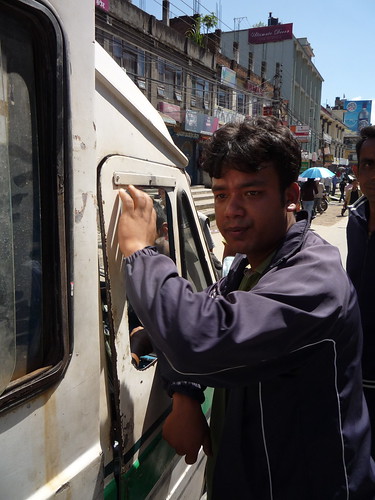
Then all of a sudden the bandh got a lot more volatile. A group of teenagers swarmed the threewheeler I was riding in, yelled at the driver, banged on its sides, and eventually, as I was turning to disembark, one of them hucked a red brick through the glass window, shattering it all over my seat. This ride was really worth the third nickel.

The riders in the threewheeler started walking home. All down the street, shop keepers pulled down their metal gates, and motorbikes scattered.

The brick thrower, it turns out, was the secretary of the Nepal
Student Union at Patan University. He said he was friends with the party member who had died this week and he was sad and angry at the police and the Home Minister over the incident. So why was he attacking the threewheeler? "They break our rules, we break their windows. Rule is rule." And with that, he was off to swarm a man riding a motorcycle, who was let go after a curt lecture.


"Rule is Rule."

Monday, September 8, 2008

Doing Business in New Road

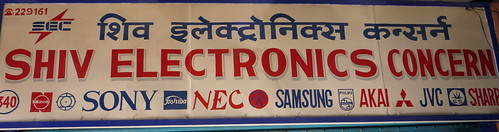
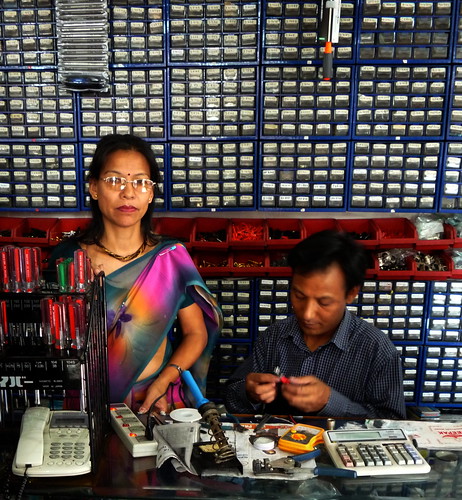
XLR microphone cables aren’t easy to come by in Kathmandu. But if you ask around enough places in New Road, the commercial neighborhood of winding alleyways and cubby-hole malls, you might eventually be directed to the fifth floor of a shopping center where Shiv Electronics Concern sells TV and computer parts. They also assemble XLR cables to custom lengths.

Shiv Electronics Concern is a little window into the shabby conditions for doing business in Kathmandu these days. When I visited it was manned by Santa Shakya and her brother Krishna, who's working on one of my cables. The shop was started by their grandfather 27 years ago. Business is down, according to Santa, because of political problems, “bad protocols,” and general mismanagement in the country. On top of that, the market’s been flooded with cheap parts from China, which are sold indiscriminately on the street, Santa said. The Concern mostly sells Taiwanese and Japanese parts, which are more expensive.

While Krishna was wiring the cables, the lights went out a few times, causing him to mismatch a pair of wires, which he fixed when the lights came back on. But this was in the same week that The Nepal Electricity Authority announced that power outages, or “load-shedding” in the local parlance, will reach up to 35 hours a week. The daily newspapers published a handy chart of outage times, according to your neighborhood.

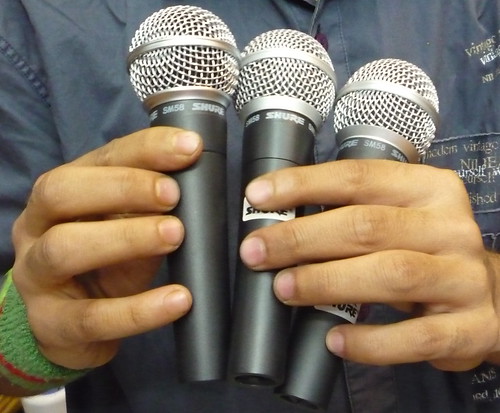
As for cheap Chinese merchandise, you don’t have to go far in New Road to find it in abundance. Just around the corner from The Concern is a storefront selling counterfeit Shure SM-58 microphones. To locate the SM-58, a stout vocal mic used by rock and roll bands everywhere, look for a large straw basket of ginger root and an old man cutting his toe nails. Turn a corner and you’ll find a whole line of Shure mics up on a shelf to your left. Here an SM-58 only costs 900 Rupees, which is just a hair under 13 US dollars. In New York it sells for over a hundred bucks.

These microphones are counterfeit of course, and the salesman wasn’t at all shy about advertising that. “These Chinese export quality SM-58’s sound just as good as the world class ones. But the real ones cost 10,000 Rupees, and you can’t get them in Kathmandu anyway.” He went on to explain that there are in fact three levels of counterfeit SM-58’s: one costing 900 rupees, one 1500, and one 2500. You can’t tell the difference by looking at it straight ahead. But if you look into the bottom of the mic you can distinguish the low, medium, and high quality fakes. See if you can tell which one’s 2500 rupees. Hint: look for the gold plated pins.

Traditional Dress

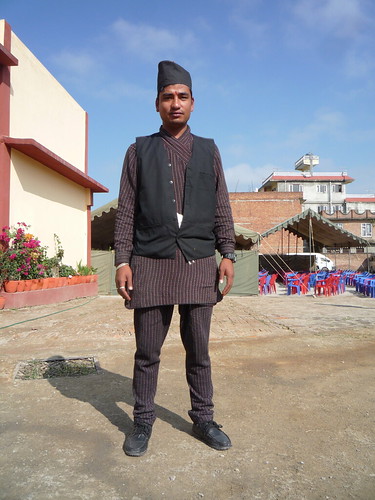
Today is Diversity Day at E's school, which here in a country with a historically very rigid caste system, chooses to actively disregard caste. But one day a year, the school celebrates it. Kids and teachers dressed according to their caste, ethnic, or regional identity (I can't begin to understand what the relationship between those three vectors is). Here's an example of a traditional Newari outfit, for instance.


More on flickr.

Sunday, September 7, 2008

Kathmandu Traffic

If you want to get a sense of how chaotic the city of Kathmandu is, go for a drive. The roads, which are shared by taxis, bikes, motorbikes, pedestrians, street dogs, chickens, vegetable carts and the occasional water buffalo, often appear lawless. The other day, for instance, I was in a taxi travelling down a narrow alleyway when the driver cut off a pair of eight year old school girls. As a nepali newspaper editor said recently, an analysis of nepali traffic can tell you a lot about the politics here: it's anarchic and selfish.

But another way to look at traffic here is that it depends on generosity and an understanding of some very subtle self-enforced rules. The fundamental approach to driving requires quick reaction, distance perception to the millimitre, and lots of horn honking. If you're a motorcycle or a car, you honk your horn on average three times per block. But unlike back home, honking isn't used as a form of aggression, it's more a courtesy. Like the way waitstaff in a fancy restaurant would lightly touch your elbow and say "pardon me." In fact pedestrians here get angry if a driver doesn't honk, because it's seen as wreckless. Luckily, not honking is rare.

One thing you almost never see in the street is frustration. Somehow gridlock is understood to be part of the game of transportation.

It’s hard to believe, but we've been told congestion is at significantly reduced levels right now because of fuel shortages. Fuel comes from India, and due to unpaid debts its flow is very irregular (waiting times at the gas station can last up to 24 or 36 hours on bad days).

Here's a video of the drive to Patan Durbar Square.